


Insoles for Ice Hockey: Everything Starts With an Edge
Updated: Sep 11
Everything in hockey starts with an edge. The first three strides out of the corner, the crossover that buys you the half meter, the stop that turns defense into offense. All of it is decided by how well the force you generate reaches a blade that is a few millimeters wide.
Between your muscles and that blade sits a stiff boot and a foot that most players have never had properly analyzed. Skaters spend seasons tuning steel, holders and stick flex, and almost no time on the surface their entire skating stride pushes against.

How moxxis benefits you in Golf
With moxxis, you gain explosive push-offs and maximum speed on every shift:
• More power reaching the blade, because the midfoot contributes instead of only the heel and the forefoot
• A stable foot inside the skate instead of one fighting to hold position
• More comfort in a boot that was never built around your foot
• Feet that tire more slowly over a full game and recover faster between them
• Reduced risk of overuse injury across a long season
Impact of Ice Hockey on Your Body
Skating is a lateral sport in a stiff boot. Your push comes from the inside edge while the boot holds your ankle nearly fixed, which means the load runs through the foot itself rather than being absorbed by the natural ankle movement you would have in a running shoe.
When the foot has no support in that shell, it stabilizes the only way it can, through muscular effort. The arch works to hold its shape, the toes grip, and the energy you meant to send into the ice gets spent inside your skate instead. That is where the familiar cramping and burning arches come from, and it is also why the fifth and sixth strides never feel like the first two.
There is a structural side to this as well, and it is the part almost nobody talks about. In a skate without proper support, the load sits on the heel and the forefoot while the midfoot carries next to nothing. The blade underneath you runs the full length of the boot, so a foot pressing on two points is using a fraction of the contact available to it. Force transfer becomes genuinely efficient only when the midfoot can deliver pressure to the blade as well.
Now add the season. Hockey players skate in a permanently flexed, forward-leaning stance, push predominantly to the sides, and shoot from one dominant side. The pattern repeats several hundred times per practice, which is precisely how small imbalances become chronic ones.

Typical problems that can develop
Foot and ankle
• The arch collapses inside the boot, so the foot cramps and burns during long shifts (arch fatigue)
• Players over-tighten laces to compensate for a loose fit, which irritates the tendons across the top of the foot (lace bite / extensor tendinitis)
• The connective tissue along the sole becomes inflamed through repetitive overload, which can lead to a bony growth on the heel bone over time (plantar fasciitis / heel spur)
• The tendon at the back of the lower leg is irritated by the sustained forward-flexed skating position (Achilles tendinopathy)
• Pressure concentrates on individual points instead of spreading across the sole, creating hot spots and numbness
Knee
• Insufficient foot support transfers directly to the knee joint (malalignment)
• Rotational and shear forces during crossovers, stops and contact stress the ligaments and the cartilage tissue between the bones
• The knee corrects what the foot could not hold, adding load to every stride
• Chronic misalignment increases the long-term risk of joint wear (osteoarthritis)
Hip and groin
• The skating stride loads the adductors continuously, and an unstable base makes them work harder still (groin overload)
• When the foot and knee compensate, the hip works asymmetrically and overloads one side (leg axis misalignment)
• Shooting and skating from one dominant side builds imbalance over a season (asymmetric overload)
• Muscles develop unevenly, leading to tension and pain (muscular imbalances)
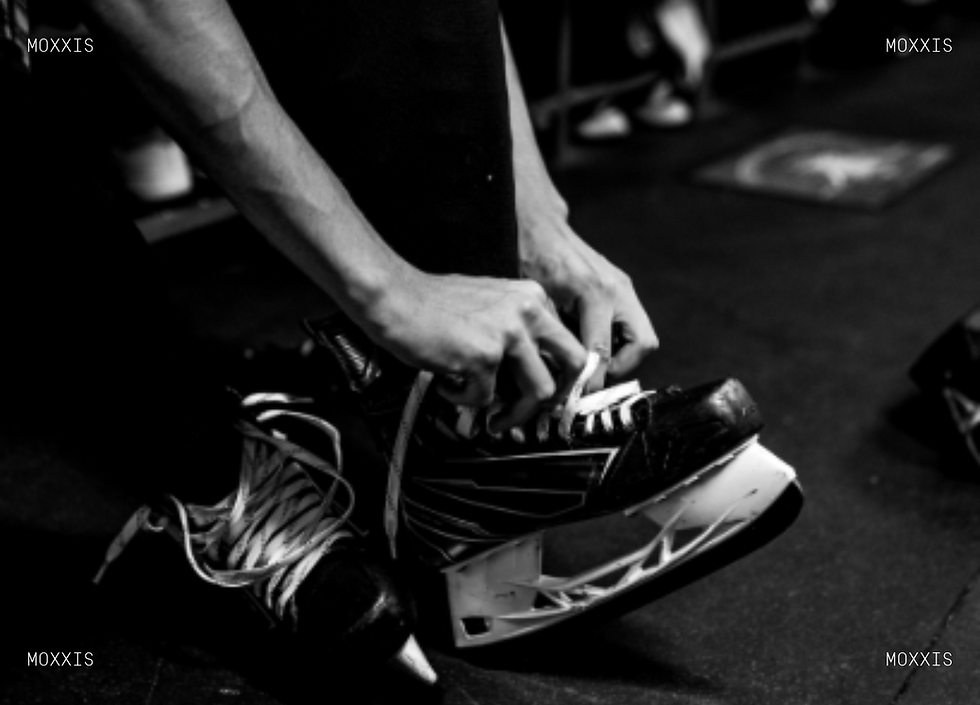
What moxxis does for you
moxxis are made from a dynamic foot analysis. Each pair is engineered around your actual foot geometry and your actual movement pattern rather than an average foot shape, so what you get is a pair built for the way you push, glide and stop on an edge. They work on the cause instead of the symptom.
They are also built for the sport you buy them for. A hockey moxxis is laid out around lateral push-off and force transfer to the blade, and around the stiff skate it has to fit into, which is a different job from the one a running or hiking moxxis does. You get your foot and your sport in the same pair.
• Power through the whole foot. The midfoot delivers pressure to the blade instead of leaving the work to the heel and forefoot alone, so more of your push reaches the ice.
• Explosive first strides. Energy goes into the edge rather than into your skate, which is exactly where speed out of the corner comes from.
• A foot that works efficiently. Supported in its actual shape, your foot puts its effort into steering and transmitting force instead of into compensating for a boot that was never built for it, and the cramping goes with it.
• Fit without over-tightening. moxxis fill the volume that otherwise gets closed by pulling the laces harder, which is what causes lace bite in the first place.
• Less fatigue, faster recovery. Your feet tire more slowly across a full game and recover quicker between them, which is what a dense schedule actually demands.

Hockey rewards the player who is a half stride quicker to the puck, and half a stride is exactly the kind of margin that gets lost between the foot and the blade. Sorting out that connection means sorting out the foundation the rest of your skating sits on.
Explosive push-offs. Maximum speed.
How to get your moxxis
1. Visit one of our locations
2. Get your feet scanned and gait analyzed
3. Personalize your moxxis with your name or quote
4. Watch your moxxis being 3D printed on-site
5. Slide them into your shoes and take off


