


Insoles for Football: Ninety Minutes Through the Thinnest Boot You Own
Updated: Sep 11
Ninety minutes of sprinting, stopping, turning and striking. Football asks more of the foot than almost any other team sport, and it asks for it in some of the thinnest and most direct footwear most athletes will ever wear.
Directness is the whole point of a football boot. You want to feel the ball, feel the ground and know exactly where your foot is, so there is very little material between you and the pitch. Studs then anchor you in place so you can accelerate, cut and plant. That combination is what makes the sport fast, and it is also what sends every one of those movements straight up through your body with almost nothing in between.
To stay sharp and pain-free over a full season, it helps to understand where all of that movement begins: the foot.
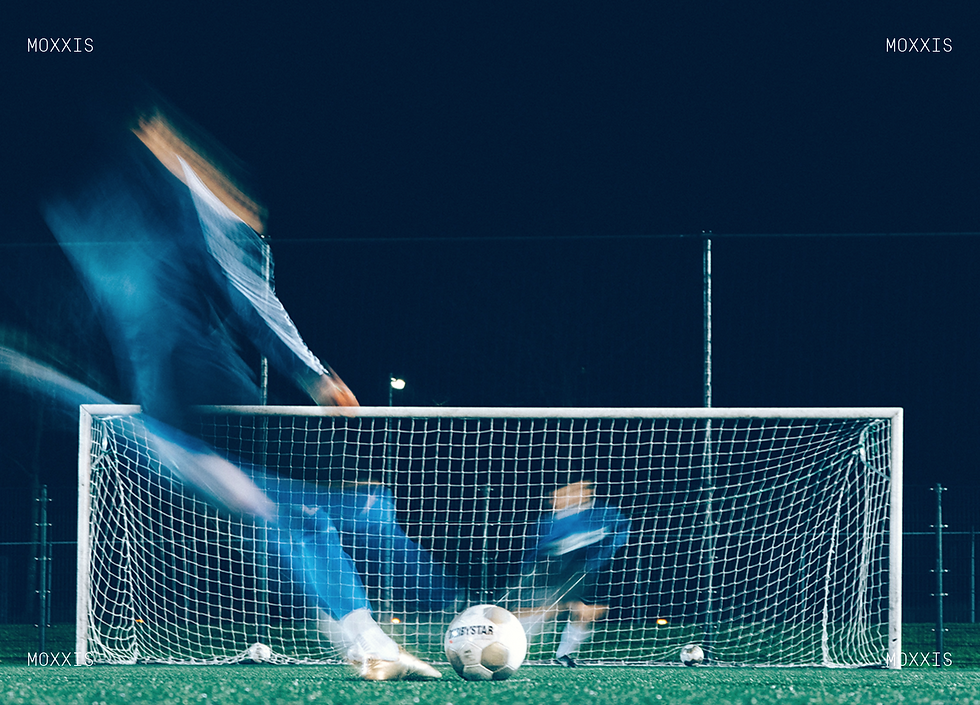
How moxxis benefits you in Football
With moxxis, you gain more control and less fatigue on every touch:
• A more stable plant foot when you shoot, cross or pass
• Improved movement and ball control
• A perfect connection from foot to boot to pitch
• Less fatigue in the final twenty minutes and faster recovery between matches
• Reduced risk of injury
Impact of Football on Your Body
Every sprint, every stop and every change of direction sends force through your foot before anything else. When your foot alignment is off, that force gets distributed unevenly, and the strain travels upward from the foot through the knee to the hip.
Consider what happens on a simple shot. Your standing leg absorbs the entire load while your body rotates around it. If the foot rolls inward as you plant, the knee follows, the hip compensates, and the movement you wanted to be explosive becomes something your body has to stabilize instead.
Then multiply that by a full season of training and matches. Football is a sport of repetition, and repetition is where small misalignments turn into real problems.
Typical problems that can develop
Foot and ankle
• The foot rolls too far inward or outward on impact, often caused by flat, low, or splayed feet (overpronation / supination)
• The connective tissue along the sole becomes inflamed through repetitive overload, which can lead to a bony growth on the heel bone over time (plantar fasciitis / heel spur)
• The ankle loses stability and the risk of rolling increases, particularly on uneven ground and during tackles (ankle instability)
• The tendon at the back of the lower leg becomes irritated through explosive push-offs and uneven load distribution (Achilles tendinopathy)
• Pressure concentrates on the ball of the foot in thin-soled boots and causes pain across the forefoot (metatarsalgia)
Knee
• Insufficient foot support transfers directly to the knee joint (malalignment)
• Rotational and shear forces during turns, tackles and shots stress the cartilage tissue between the bones (meniscal irritation)
• The tendon below the kneecap becomes overloaded through repeated sprinting and jumping (patellar tendinopathy / "Jumper's Knee")
• Chronic misalignment increases the long-term risk of joint wear (osteoarthritis)
Hip and groin
• When the foot and knee compensate, the hip works asymmetrically and overloads one side (leg axis misalignment)
• The dominant kicking side does far more work than the other, which builds imbalance over a season (asymmetric overload)
• The adductors take on repeated strain during passing, shooting and lateral movement (groin overload)
• Muscles develop unevenly, leading to tension and pain (muscular imbalances)

What moxxis does for you
moxxis are made from a dynamic foot analysis. Each pair is engineered around your actual foot geometry and your actual movement pattern rather than an average foot shape, so what you get is a pair built for the way you sprint, plant and strike the ball. They work on the cause instead of the symptom.
They are also built for the sport you buy them for. A football moxxis is laid out around sprinting, planting and striking, and around the thin, direct boot it has to fit into, which is a different job from the one a running or hiking moxxis does. You get your foot and your sport in the same pair.
• A plant foot that holds. Your foot is precisely guided, so your standing leg keeps its position through shots, turns and duels instead of rolling under you.
• A sharper first step. More of your energy reaches the ground rather than being absorbed inside the boot, which shows up in acceleration and in how fast you change direction.
• Cleaner contact with the ball. A foot that sits stable in the boot gives you a more reliable connection to the ground, and that connection is what ball control is built on.
• Less strain over a season. Pressure is distributed evenly across the foot, relieving knees, hips and adductors and lowering the risk of the overuse injuries that cost players weeks.
• Fresher legs, faster recovery. A supported foot accumulates less fatigue across ninety minutes, so you finish stronger and come back quicker for the next session.

In a sport decided by the first three meters and the last ten minutes, the foundation you play on is worth optimizing. Over ninety minutes, better control and less fatigue decide whether you finish the match the way you started it.
Kick sharper. Dribble faster.
How to get your moxxis
1. Visit one of our locations
2. Get your feet scanned and gait analyzed
3. Personalize your moxxis with your name or quote
4. Watch your moxxis being 3D printed on-site
5. Slide them into your shoes and take off


