


Insoles for Hiking: A Tour Is Decided on the Way Down
Updated: Sep 11
A hike is decided on the way down.
Most people plan for the climb, train for the climb, and talk about the climb. The descent is where the load actually lands, because gravity stops being resistance and starts being force, and your feet absorb every step of it with a pack on your back and hours already behind you.
Which is why so many hikes end the same way. Great morning, strong summit, and a last hour spent negotiating with your own feet.
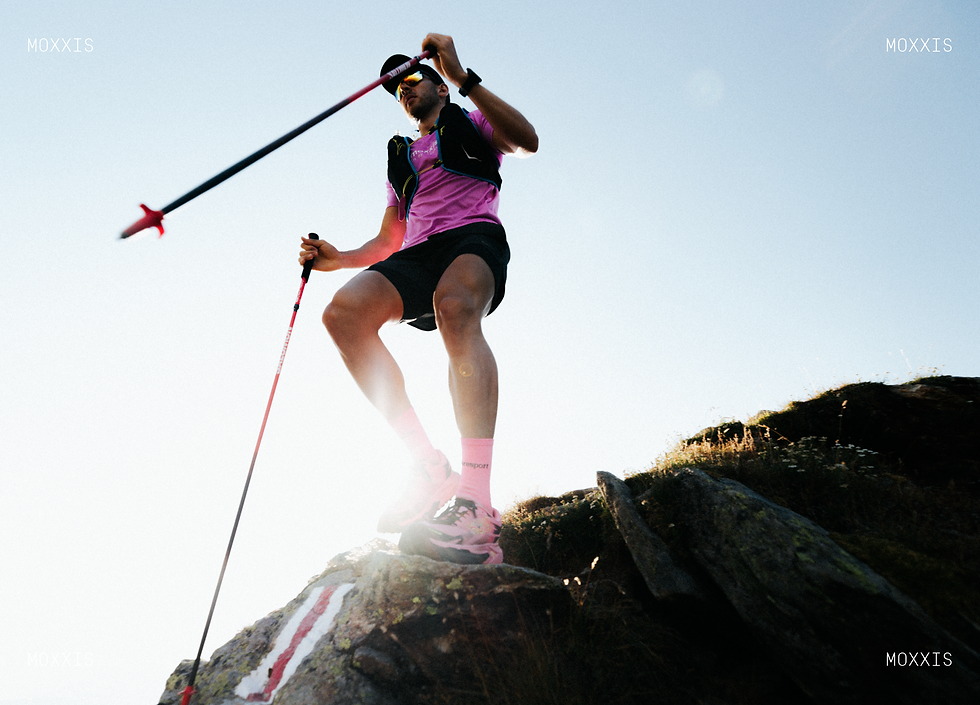
How moxxis benefits you Hiking
With moxxis, you gain an optimal fit and lasting endurance on every tour:
• A secure fit inside the boot, with less foot movement and fewer hot spots
• No power lost to a foot sliding around inside the boot
• Stable footing on uneven terrain and loose ground
• Built-in shock absorption on long descents, where the load is highest
• Less fatigue and reduced strain on knees and hips over a full day out
Impact of Hiking on Your Body
Hiking looks gentle because it is slow. The load is real anyway, because it lasts. Hours of continuous walking on uneven ground, often with additional weight, means your feet handle more total work in a day than they would in a week of ordinary life.
The descent concentrates that load. Going downhill, your muscles work while lengthening rather than shortening, which is more demanding and produces more of the next-day soreness hikers know well. Each step lands with more force than it does on the flat, and the foot has to control that landing on ground that is rarely level.
Your boot gives you little help here. Hiking boots are built stiff and hard on purpose, because that stiffness is what protects your foot from rock and root and keeps you stable on rough ground. What you give up for it is damping. Very little of the force from a downhill step gets absorbed by the sole, so it reaches your foot close to full strength and carries on upward from there, step after step, for the entire descent.
There is a second issue specific to boots. Feet swell over the course of a long day, and a boot that fits perfectly in the morning fits differently by late afternoon. If the foot can move inside the boot, friction follows, and friction is where blisters, bruised toenails and hot spots come from. Most hikers respond by lacing tighter, which solves the movement and creates a pressure problem instead.
That movement costs you power as well. Every millimeter the foot travels inside the boot is force that went into the boot rather than into the ground, and on a long ascent those millimeters add up to real energy you never get back.
Typical problems that can develop
Foot and ankle
• The foot moves inside the boot, and the resulting friction creates blisters and hot spots
• The connective tissue along the sole becomes inflamed through hours of continuous load, which can lead to a bony growth on the heel bone over time (plantar fasciitis / heel spur)
• The ankle loses stability on uneven terrain and the risk of rolling increases (ankle instability)
• The foot slides forward on steep descents and the toes are pressed against the boot (bruised or lost toenails)
• Pressure concentrates on individual points instead of spreading across the sole, causing forefoot pain (metatarsalgia)
• The tendon at the back of the lower leg is irritated by long ascents (Achilles tendinopathy)
Knee
• Insufficient foot support transfers directly to the knee joint (malalignment)
• Descending loads the knee repeatedly, and an unstable landing adds shear force to every step
• Undamped impact from a hard boot sole travels straight through the foot to the knee
• The kneecap is pulled off its intended track by inward rotation of the lower leg (patellofemoral pain)
• Chronic misalignment increases the long-term risk of joint wear (osteoarthritis)
Hip and back
• When the foot and knee compensate, the hip works asymmetrically and overloads one side (leg axis misalignment)
• Pack weight increases every load already travelling up through the foot
• Muscles develop unevenly, leading to tension and pain (muscular imbalances)

What moxxis does for you
moxxis are made from a dynamic foot analysis. Each pair is engineered around your actual foot geometry and your actual movement pattern rather than an average foot shape, so what you get is a pair built for the way you climb, descend and carry weight over a long day. They work on the cause instead of the symptom.
They are also built for the activity you buy them for. A hiking moxxis is laid out around long descents and pack weight, and around the volume of a hiking boot, which is a different job from the one a running or ski moxxis does. You get your foot and your terrain in the same pair.
• A boot that fits from the first step. moxxis fill the volume between your foot and your boot, so the foot sits secure, the friction that causes blisters has nowhere to start, and the power in each step goes into the ground.
• Built-in shock absorption. A stiff boot sole passes impact almost straight through. moxxis absorb part of that force before it reaches your foot, which counts most on the descent, where every step lands hard.
• Sure footing on bad ground. Your foot is precisely guided, which matters most exactly where the terrain is least predictable.
• Relief for the knees on the way down. Pressure is spread evenly across the sole, so the descent costs your joints considerably less.
• Lasting endurance. Less energy spent stabilizing means more left for the part of the day you came for.
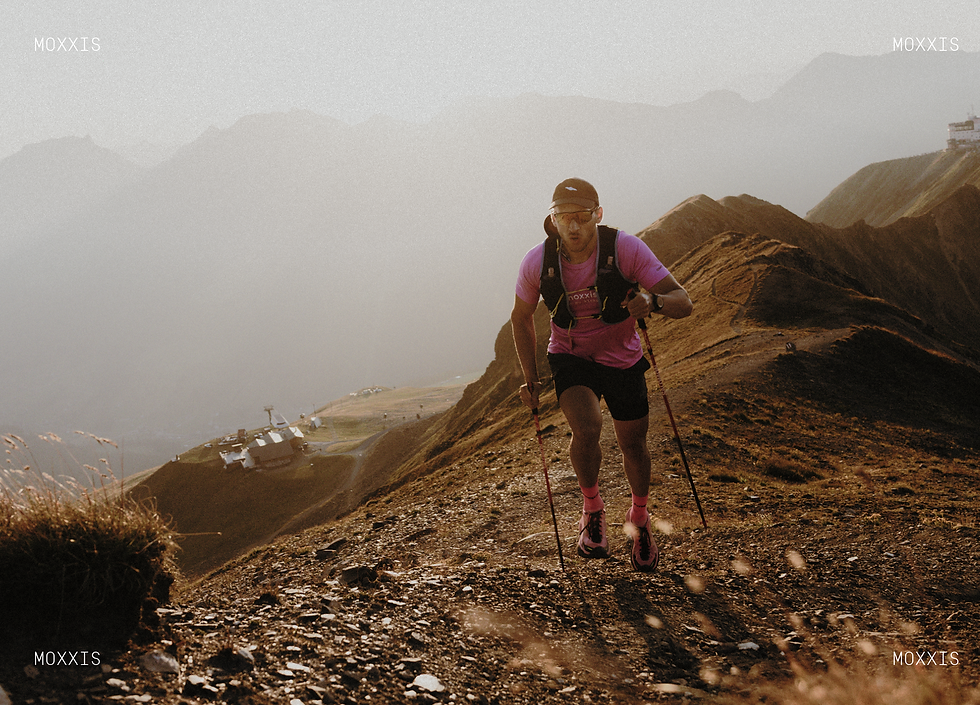
The best hiking boot on the market is still built around an average foot, and it is stiff and hard by design. It is also the only piece of equipment that has to work perfectly for eight hours straight. Fixing the inside of the boot costs less than replacing it and changes considerably more.
Optimal fit. Lasting endurance.
How to get your moxxis
1. Visit one of our locations
2. Get your feet scanned and gait analyzed
3. Personalize your moxxis with your name or quote
4. Watch your moxxis being 3D printed on-site
5. Slide them into your shoes and take off


